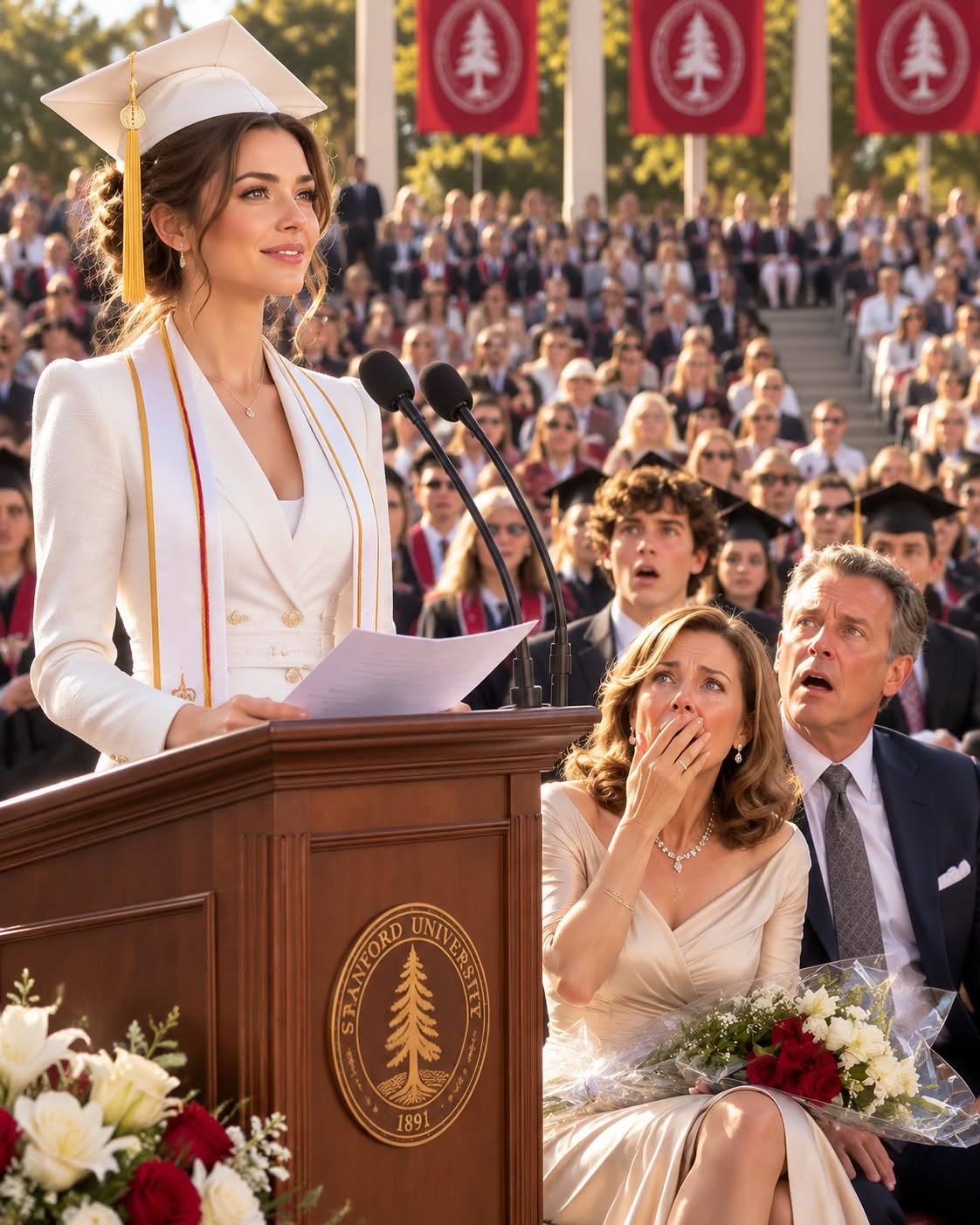
For one suspended second, the entire stadium seemed to narrow around my mother’s face.
Not the thousands of graduates shifting in their folding chairs. Not the bright Stanford banners snapping gently in the California breeze. Not the restless murmur of families searching for the best angle on their phones.
Just my mother.
Her cream blazer. Her pearl earrings. The smile she had worn for Derek like a badge.
And then the way it vanished.
I had imagined that moment more times than I wanted to admit.
In the quiet hours after long workdays, when the office lights at Solar Reach flickered above empty desks and the janitor’s cart rattled down the hallway, I had pictured myself standing tall while my parents looked up at me with regret. I had imagined satisfaction, maybe even triumph. A clean, cinematic feeling. The daughter they overlooked becoming someone impossible to ignore.
But standing there, with the sun warm on my face and a microphone waiting in front of me, I felt something far more complicated.
I saw my mother’s mouth part slightly, as if she had been about to say something and had forgotten how. My father lowered his phone. Derek, standing near the front rows in his cap and gown, turned halfway toward Section 114, then back toward the stage.
He knew.
Or at least he knew something.
That realization landed harder than I expected.
The dean smiled beside me, unaware of the history gathering like a storm beneath the surface.
“Dr. Mitchell,” he said quietly, stepping aside.
I placed my notes on the podium, though I barely needed them. I had written this speech at two in the morning in a hotel room overlooking campus, the same campus where I had once eaten crackers for dinner because my research stipend had run thin before rent was due. The same campus where I had cried in bathroom stalls after experiments failed. The same campus where I had learned that loneliness could become either a wound or a forge.
I looked out at the graduates.
So many bright faces. So many families leaning forward with pride.
And somewhere among them sat mine.
I took a breath.
“Good morning,” I said.
My voice carried across the stadium, calm and steadier than I felt.
The crowd answered with polite applause.
“Two years ago,” I began, “I stood on this campus wearing a different robe, crossing a different stage. I had just completed my doctorate after eight years of research in energy systems. That morning, I adjusted my hood by myself in front of a secondhand mirror.”
A hush settled.
I did not look at my mother. Not yet.
“I was proud,” I continued. “I was exhausted. I was terrified. And I was alone.”
The words moved through the audience like wind through tall grass.
“I had spent most of my adult life working on a question that sounded simple: What would it take to bring reliable electricity to places where darkness still decides what is possible?”
I saw a graduate in the front row lift her eyes from her program.
“I did not come from a family of scientists. I did not grow up surrounded by laboratories or investors or people who used words like infrastructure and scalability over dinner. I grew up in a house where achievement mattered very much, but only certain achievements counted.”
My fingers rested lightly on the edge of the podium.
“I learned early that some dreams are easy for others to admire because they come with familiar titles. Lawyer. Banker. Executive. Consultant. And some dreams are harder to explain because they start with failure, uncertainty, and years of work no one can see.”
In Section 114, my father had stopped recording completely.
My mother sat perfectly still.
I could have said more. I could have quoted the text message word for word. I could have watched the entire audience turn to search for the people who had sent it. I could have taken the wound they gave me and placed it in public view.
But the strange thing about standing under that bright sky was that I no longer wanted to bleed for applause.
So I looked back at the graduates.
“Today, many of you are receiving degrees that will open doors. Some of you already know exactly which doors you want. Some of you are pretending you know because everyone keeps asking, and it is easier to smile than to admit uncertainty.”
A ripple of laughter passed through the rows.
“That uncertainty is not failure. It is part of the work. But I want to tell you something that took me too long to learn. Do not measure your future only by who claps at the beginning.”
My throat tightened, but I kept going.
“Some of the most important work you will ever do may be misunderstood by people you love. Some of it may be dismissed. Some of it may require you to keep showing up without approval, without applause, and sometimes without an audience at all.”
I paused.
“Keep showing up anyway.”
The first real applause rose then, warm and unexpected. I waited for it to settle.
“At Solar Reach, our earliest office had eleven chairs and only seven of them were safe to sit on. We had a coffee machine that made noises like a small aircraft, a whiteboard full of impossible deadlines, and enough money in the bank to make everyone nervous.”
Laughter again, louder this time.
“Our first field prototype failed in forty-three minutes. Our second failed before it left the warehouse. At one point, a battery management system caught a software bug that made our lead engineer stare at the ceiling for so long I thought he was praying.”
More laughter.
“But eventually, after months of failure, we watched a village outside Nairobi light up after sunset. I will never forget the sound that followed. It was not cheering, not exactly. It was wonder. Children running toward light. A nurse standing in a clinic doorway with her hand over her mouth. A shopkeeper switching on a sign he had painted three years earlier, waiting for the day he could finally use it.”
The stadium quieted again.
“That was the moment I understood that value is not always recognized by the people closest to you. Sometimes value is proven in the lives changed by what you refused to abandon.”
I turned one page in my notes.
“And that brings me to all of you.”
For the next twelve minutes, I spoke about leadership as service, about ambition without arrogance, about the difference between building something profitable and building something worth being responsible for. I told them not to confuse speed with direction. I told them numbers mattered, but names mattered too. I told them the spreadsheet and the human story had to remain in the same room.
I never mentioned my parents directly.
I never mentioned Derek.
But when I said, “Sometimes the people who doubt you are not villains. Sometimes they are frightened people who only trust roads they have already seen,” my mother lowered her face into her hands.
That was the moment I almost lost my place.
For years, I had imagined her embarrassment as justice. But seeing it did not make me feel powerful. It made me feel tired. It made me remember being six years old at the kitchen table, showing her a drawing of the moon, waiting for her to put it on the refrigerator.
It made me remember wanting less than praise.
Just a place.
I finished my speech with a story I had not planned to tell.
“When I was a little girl,” I said, “there was a storm that knocked out power in our neighborhood for almost two days. I remember sitting in the dark with a flashlight under my chin, trying to make my brother laugh. I remember being afraid every time the wind hit the windows. But I also remember looking across the street and seeing one house with a generator. One glowing window in a row of dark homes.”
I looked toward the horizon beyond the stadium.
“I think part of me has been chasing that window ever since. Not because light solves everything. It doesn’t. But because light gives people a little more time. To study. To heal. To gather. To hope. And sometimes, a little more time changes the entire story.”
I let the silence hold.
“So as you leave here today, I hope you build things that make the world less dark for someone. I hope you have the courage to continue when approval does not arrive on schedule. And I hope, when someone tells you your dream does not matter, you remember that they may simply be standing too far away to see what it can become.”
The applause began before I stepped back.
At first it was polite.
Then it grew.
Rows of graduates stood. Families followed. The sound rolled through the stadium, bright and enormous, until I felt it in my ribs.
I smiled because that was what the moment required.
But my eyes found Derek.
He was clapping too.
Slowly. Carefully. His face unreadable.
Behind him, my father had risen halfway from his seat, as though caught between standing and staying hidden. My mother remained seated, hands folded tightly in her lap.
When I walked offstage, the dean touched my shoulder.
“That was beautiful,” he said. “Truly.”
“Thank you,” I replied.
Backstage smelled of sunscreen, dust, bottled water, and fresh flowers. Volunteers moved around me with headsets and clipboards. Someone handed me a program to sign. Someone else asked for a photo.
I did what was expected.
I smiled. I shook hands. I answered questions about Solar Reach, about financing models, about rural electrification and battery storage, about whether I thought clean energy startups could remain mission-driven after major investment.
All the while, I felt the presence of Section 114 like a hand pressed between my shoulder blades.
I had not come for a confrontation.
I had told myself that all morning.
I had come to speak.
I had come to honor the graduates.
I had come because Stanford asked, because the company mattered, because the work mattered.
And perhaps, if I was honest, because some small unhealed part of me wanted my parents to see me clearly at least once.
After the ceremony ended, I escaped to a quiet hallway beneath the stadium. The concrete walls held the coolness of shade. Above me, the muffled thunder of families reuniting carried through the structure.
I leaned against the wall and closed my eyes.
“Dr. Mitchell?”
I opened them.
A young woman in a graduation gown stood a few feet away. Her tassel swung beside her cheek, and her eyes were red as though she had been crying.
“I’m sorry,” she said quickly. “I don’t mean to bother you.”
“You’re not bothering me.”
She swallowed. “My parents didn’t come either.”
The words entered the air softly, but they struck with force.
I stepped away from the wall.
“They wanted me to go into medicine,” she continued. “I chose operations and sustainability. They said it was a phase. Then they said they were busy. But really, they were disappointed.”
Her fingers tightened around her diploma cover.
“When you said not to measure your future by who claps at the beginning…” She let out a small, embarrassed laugh. “I needed that.”
For a moment, I could not speak.
Then I said, “What’s your name?”
“Priya.”
“Priya,” I said, “I’m proud of you.”
Her face changed.
Not dramatically. Not like in movies. But something inside her seemed to unclench.
“Thank you,” she whispered.
We spoke for a few minutes. She told me about her capstone project, about water systems in drought-prone regions, about a job offer she was scared to accept because it was in another state and would make the distance with her family feel permanent.
“There is a difference between distance and abandonment,” I told her. “Sometimes distance is where you become strong enough to return without disappearing.”
She nodded as if she understood, though I was not sure I fully did.
After she left, I stayed in the hallway longer than necessary.
Then I heard my name.
Not Dr. Mitchell.
Sarah.
I turned.
Derek stood at the far end of the corridor, still in his graduation robe, holding his cap in one hand.
For a second, neither of us moved.
My brother had always been easy to love from a distance and difficult up close. He was charming without effort, handsome in the careless way of men who had never been asked to apologize for taking up space. Growing up, he was the sun around which our household arranged itself. His soccer games were family events. His report cards were framed conversations. His internships were celebrated with dinners.
Mine were acknowledged between errands.
But Derek had not created that imbalance. He had benefited from it, yes. He had rarely challenged it. But he had not been the architect.
At least that was what I had told myself on generous days.
He walked toward me slowly.
“That was some speech,” he said.
“Congratulations on graduating.”
He gave a short laugh. “That’s what you’re going with?”
“It seems appropriate.”
“Sarah.”
His voice softened in a way I had not heard in years.
I looked past him toward the open end of the corridor, where sunlight spilled across the floor.
“Did you know?” I asked.
He did not pretend to misunderstand.
“That you were the speaker? No. Not until this morning.”
“This morning?”
He looked down at his cap. “There was a printed program in the hotel lobby. Dad picked one up. Mom saw your name and said it had to be another Sarah Mitchell.”
A faint, humorless smile touched his mouth.
“She said there was no way Stanford would ask you to speak at my ceremony.”
The words should have hurt.
They did, but not sharply. More like touching a bruise and finding it old.
“And you?” I asked.
“I knew it was you.”
“Did you tell them?”
“I said it was probably you.” He looked up. “Mom told me not to be ridiculous.”
Of course she had.
A group of graduates passed by the corridor entrance, laughing, arms around one another. Their joy echoed briefly, then faded.
Derek shifted his weight.
“I didn’t know they skipped your graduation,” he said.
I stared at him.
“What?”
“I knew they didn’t go,” he said quickly. “But I didn’t know how it happened. I didn’t know about the texts. I thought…” He rubbed the back of his neck. “I thought you didn’t want anyone there.”
The sentence left me colder than I expected.
“Why would you think that?”
“Mom said you told them not to come.”
I almost laughed.
It came out as a breath.
“She said you were too busy. That you thought graduation ceremonies were performative. That you didn’t want family making a fuss.”
I looked at my brother, searching for signs of evasion, but he seemed genuinely uncomfortable.
“You believed her?”
“I didn’t know why she’d lie about that.”
There it was.
The simple, devastating privilege of never having to question whether our mother’s version of events had been edited at someone else’s expense.
“She told me my PhD graduation wasn’t worth the flight,” I said. “She said your MBA was the one that actually mattered.”
Derek flinched.
“She said what?”
I took out my phone before I could rethink it. The message was buried deep, but I knew where it lived. Some wounds become archives. I opened the screenshot I had saved two years earlier, not because I wanted to keep the pain, but because some part of me knew I might one day need proof that it had happened.
I handed him the phone.
His eyes moved across the screen.
Once.
Twice.
His jaw tightened.
“Sarah,” he said quietly.
I took the phone back.
“Now you know.”
He leaned against the opposite wall, the black fabric of his robe falling around him. For the first time all day, he looked less like the celebrated son and more like the boy who used to sneak into my room during thunderstorms.
“I’m sorry,” he said.
I wanted to reject it. It would have been easier to say he was too late, that apologies did not retroactively fill empty chairs, that he had two years to notice my absence from the family story and had chosen not to.
But the words caught when I saw his face.
So I said the truth.
“I don’t know what to do with that yet.”
He nodded. “That’s fair.”
Above us, the ceremony crowd began to thicken, voices swelling near the exits.
“Mom wants to see you,” he said.
My stomach tightened.
“I’m sure she does.”
“She’s upset.”
I looked at him.
He winced. “Bad word choice.”
“Yes.”
“She’s… shaken.”
“That sounds closer.”
“She said she wants to explain.”
I almost smiled. “Explain what?”
“I don’t know.”
“Derek, I didn’t come here to punish her.”
“I know.”
“Do you?”
He held my gaze. “After that speech? Yeah. I do.”
Something in his answer disarmed me.
For years, I had imagined my brother as part of the wall between me and my parents. Now here he was, standing in a corridor, looking as though he had discovered a door neither of us knew existed.
“I have a reception,” I said.
“Right. Of course.”
“And you have your family dinner.”
His expression changed.
“What?”
“Mom told me months ago. Big dinner. Favorite restaurant. Champagne. All the things.”
He looked away.
“Sarah, I didn’t know you weren’t invited.”
That one did not surprise me.
But it still hurt.
A silence stretched between us.
Then he said, “Come.”
“No.”
“Please.”
“No, Derek.”
“Not for them. For me.”
I stared at him.
He swallowed. “I want my sister at my graduation dinner.”
The word sister moved through me with unexpected force.
For a long time, I had not felt like his sister. I had felt like a footnote in his biography. The smart one. The difficult one. The one who missed holidays because she was “still in school.” The one whose work nobody understood, so nobody asked about it.
“You should have asked before today,” I said.
“I know.”
“You should have noticed.”
“I know.”
“And I’m not sure one hallway apology fixes that.”
“I know that too.”
He sounded so unlike himself that I looked at him more closely.
There were shadows beneath his eyes. His smile, usually quick and polished, did not appear. The confident MBA graduate standing before me looked strangely weary.
“What’s going on with you?” I asked.
He blinked. “What do you mean?”
“I mean you don’t look happy.”
He laughed, but there was no humor in it.
“I just graduated from business school. I’m thrilled.”
“No, you’re performing thrilled.”
His eyes flickered.
I knew that look. I had worn it at family holidays.
Before he could answer, a voice called from the corridor entrance.
“Sarah.”
My body recognized my mother’s voice before my mind did.
Derek turned.
My parents stood together beneath a red directional sign pointing toward guest services. My father looked older than he had in my memory, his hair thinner, his shoulders slightly rounded. My mother held her purse with both hands in front of her, knuckles pale against the leather strap.
For one absurd moment, I thought of the cream blazer again. How carefully she must have chosen it. How proud she had expected to feel today.
“Hello, Mom,” I said.
She walked forward a few steps, then stopped. Her eyes searched my face as if trying to reconcile the woman before her with the daughter she had filed away in a simpler category.
“I didn’t know,” she said.
It was the wrong beginning.
I felt Derek tense beside me.
“You didn’t know I was speaking?” I asked.
“No. I mean…” She looked toward my father. He said nothing. “I didn’t know it had become so big. Your company.”
My company.
Not my work. Not my life.
“I see,” I said.
Her face flushed. “That came out wrong.”
“A lot of things did.”
My father cleared his throat.
“Sarah, your speech was impressive.”
Impressive.
The kind of word someone uses for a well-organized garage.
“Thank you,” I said.
My mother’s eyes shone, though no tears fell. “Why didn’t you tell us?”
I stared at her.
“That you were invited,” she said quickly. “That you were doing so well. That Solar Reach had grown like this.”
For a few seconds, the only sound was the distant noise of celebration outside.
Then I said, “Because you told me my work was embarrassing.”
Her lips trembled. “I was worried about you.”
“No,” I said gently, surprising myself with the softness of my voice. “You were embarrassed by me.”
She looked as though I had slapped her, though I had not raised my voice.
“That’s not fair.”
“Neither was crossing my graduation stage alone.”
My father looked down.
My mother’s mouth opened, but no words came.
Derek stepped beside me. Not in front of me. Beside me.
“Mom,” he said, “did you tell me Sarah didn’t want anyone at her PhD ceremony?”
My mother’s eyes darted to him.
“This isn’t the time.”
“It seems like the time.”
“Derek.”
“Did you?”
Her grip on her purse tightened.
“I may have said something like that because I didn’t want you feeling guilty. You had exams. Your internship interviews.”
I looked at Derek.
He looked sick.
“I didn’t have exams that weekend,” he said.
My mother’s face hardened, just slightly. It was a familiar shift. The moment vulnerability became control.
“You don’t understand what it was like,” she said. “We didn’t know where Sarah was headed. Eight years is a long time. We were afraid she was hiding in school because she didn’t know how to live in the real world.”
The real world.
I almost laughed again.
“I was building battery models and writing grant proposals while teaching undergraduates and sleeping four hours a night.”
“We didn’t know that.”
“You didn’t ask.”
The words fell cleanly.
My mother blinked.
For the first time, she seemed not offended, not defensive, but genuinely uncertain.
My father finally spoke.
“We should have asked.”
I turned to him.
He looked at me with a sadness that felt late, but not false.
“I should have called you,” he said. “More than I did. I told myself you were busy. I told myself you’d reach out when you needed us.”
“I did need you,” I said.
His face crumpled slightly.
The sight made me look away.
There are moments when anger is easier than grief because anger gives you something to hold. Grief only opens its hands and shows you what is missing.
“I have to go,” I said.
“Sarah, please,” my mother said. “Come to dinner.”
I met her eyes.
“Why?”
The question seemed to confuse her.
“Because we’re family.”
I waited.
She looked at Derek. Then at my father. Then back at me.
“Because we should talk.”
“About what?”
“Everything.”
“That’s too broad.”
A flicker of irritation crossed her face, but she swallowed it.
“About your graduation. About what happened. About why I said what I said.”
“And why did you?”
The corridor seemed to tighten around us.
My mother looked suddenly exposed.
“I was scared,” she said.
I did not answer.
“You were brilliant as a child,” she continued, voice quieter now. “Always asking questions I couldn’t answer. Taking apart radios. Drawing machines. Your teachers said words like gifted, exceptional, advanced. And I was proud. I was.”
I remembered those teachers. I remembered my mother smiling at parent conferences, then growing quiet in the car when they suggested science camps and advanced programs we could not afford.
“But then everything with your uncle happened,” she said.
I froze.
My father’s head snapped toward her.
“Elaine,” he warned.
Derek looked between them. “What about Uncle Paul?”
My mother’s face changed as if she had said something she had not meant to say.
A memory stirred in me.
Uncle Paul had been my mother’s younger brother. In family stories, he was mentioned rarely and vaguely. A genius, people said. A dreamer. Someone who could have been great if he had been more practical. He died when I was nine, though no one ever explained much beyond “an accident” and “a difficult time.”
“What does Uncle Paul have to do with me?” I asked.
My mother pressed her lips together.
“Nothing,” my father said too quickly.
But it was too late.
The air had shifted.
Derek’s brows drew together. “Mom?”
She closed her eyes.
For a moment, I thought she might finally tell the truth.
Instead, she straightened.
“I shouldn’t have brought him up.”
“Too late,” I said.
“Sarah, not here.”
“Then where?”
My mother looked past me toward the reception area, where people in suits and graduation gowns moved beneath strings of red and white balloons.
“Dinner,” she said. “Come to dinner, and I’ll explain.”
I shook my head.
“No.”
“Please.”
“No,” I repeated. “I’m not going to sit through a celebration where everyone pretends this is a normal family moment while you decide how much truth I deserve.”
Her eyes filled at last.
“Then coffee,” she said. “Tomorrow morning. Just you and me.”
The request surprised me.
My father looked surprised too.
Derek watched me carefully.
I wanted to refuse. Every instinct built from years of disappointment told me not to step back into the old room, not to sit across from her and offer another chance to minimize what she had done.
But Uncle Paul’s name had opened something.
A door in a hallway I had thought was sealed.
“What time?” I asked.
My mother exhaled.
“Nine?”
“Seven-thirty,” I said. “I have meetings.”
“Seven-thirty,” she agreed quickly.
“I choose the place.”
“Of course.”
“And if you lie to me, I leave.”
She flinched.
“All right.”
I looked at my father.
“Does this involve you too?”
He hesitated.
“Yes,” he said softly.
“Then you should come.”
My mother turned sharply. “But you said just us.”
“I changed my mind,” I said.
For the first time that day, I saw something like respect pass across Derek’s face.
I left before anyone could say more.
Outside, campus was impossibly beautiful. Families posed beneath palm trees. Graduates threw caps into the air. Bouquets wrapped in cellophane flashed pink and yellow in the sun. Everywhere I looked, people were holding one another.
I walked through it all alone, but it did not feel the same as before.
Two years earlier, loneliness had wrapped around me like proof of being unwanted.
Today, it felt more like space.
Painful space, yes.
But space I owned.
At the reception, I became Dr. Mitchell again. Investors shook my hand. Faculty members asked about partnerships. A dean from the engineering school told me they were developing a new initiative around energy access and wanted Solar Reach involved.
I answered. I smiled. I performed competence with the ease of long practice.
But beneath it all, Uncle Paul’s name kept repeating.
Everything with your uncle.
That evening, back at my hotel, I kicked off my heels and searched through old family records online. Paul Whitaker. My mother’s maiden name. I found almost nothing at first. An old obituary. A local newspaper mention from 2003. A memorial scholarship that no longer appeared active.
Then, buried in a scanned archive from a regional newspaper, I found a headline that made my pulse slow.
LOCAL ENGINEER DIES AFTER STARTUP COLLAPSE
The article was short. Too short for a life.
Paul Whitaker, thirty-four, had been developing low-cost modular power systems for rural communities. His company had failed after a major investor withdrew funding. He had died six weeks later in a car accident outside Portland.
I read the paragraph three times.
Low-cost modular power systems.
Rural communities.
My hands went cold.
I clicked on another article.
This one included a photograph.
A thin man with kind eyes stood beside a workbench, holding what looked like an early prototype of a portable energy unit. Behind him, taped crookedly to the wall, was a child’s drawing.
A moon.
A row of dark houses.
One glowing window.
My breath caught.
I knew that drawing.
Not because I remembered making that exact one, but because I had drawn the same image over and over as a child. The storm. The generator. The glowing window across the street.
Had Uncle Paul seen it?
Had he kept one?
I leaned closer to the screen, heart thudding.
The caption beneath the photo read: Engineer Paul Whitaker pictured in his workshop with a concept sketch by his niece, Sarah Mitchell, age 7.
I sat back slowly.
My hotel room was silent except for the hum of the air conditioner.
For years, I had believed my dream began with a storm and a childhood memory.
But maybe someone had seen it before I understood it.
Maybe someone had encouraged it.
Maybe someone had built toward the same light and vanished from our family story because his failure frightened them so deeply that they tried to bury every spark that looked like his.
My phone buzzed on the nightstand.
A message from Derek.
I stared at it for several seconds before opening it.
Found something in Dad’s suitcase. I don’t think they know I saw it.
Then a photo appeared.
It showed a worn manila folder, the edges bent with age. Across the tab, in my father’s handwriting, were three words.
PAUL / SARAH / PATENT
My heart began to pound.
Before I could type a response, Derek sent one more message.
Sarah, why is your name on Uncle Paul’s old invention file?
Yes. The full story will be in the comments below.👇👇
END OF PART 2 – LIKE, SHARE AND COMMENT “THE ENTIRE STORY” IF YOU WANT TO READ THE FULL STORY
