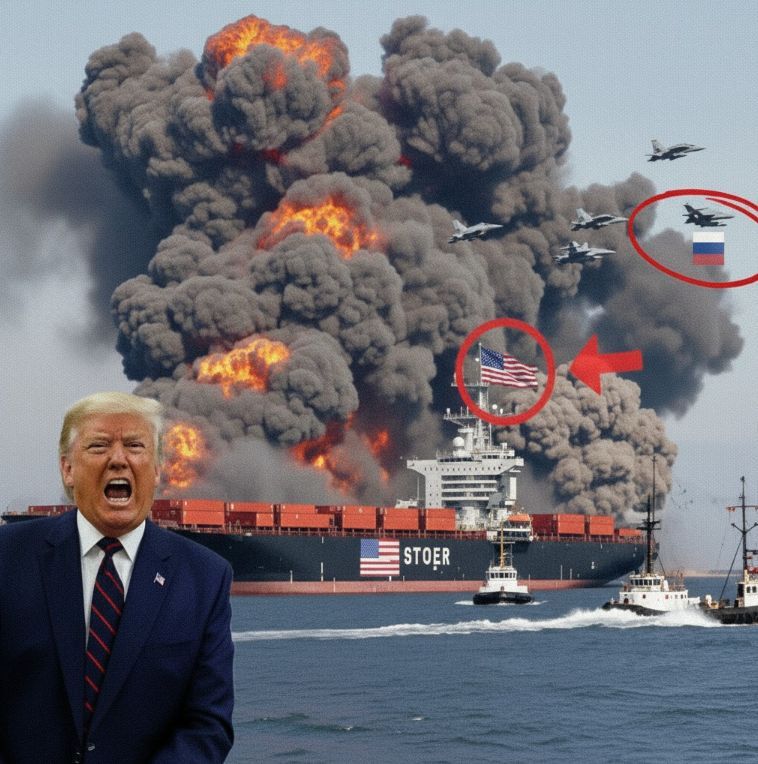
There are no credible reports that anything like this has happened, and a claim that a single Sukhoi Su-57 destroyed a U.S. aircraft carrier carrying 200 fighter jets is extraordinarily unlikely in reality. Modern carriers are among the most heavily defended assets in the world, protected by layered missile defense systems, escort ships, submarines, and constant surveillance.
That said, I can turn your idea into a fictional, cinematic story—a high-stakes scenario imagining how such an event might unfold in a dramatic narrative.
The sky over the cold gray ocean was silent—too silent. Lieutenant Colonel Sergei Volkov sat inside the cockpit of his Sukhoi Su-57, his gloved hands steady on the controls, though his pulse told a different story. The mission briefing had been clear, but almost unbelievable: penetrate one of the most heavily defended naval formations on Earth and strike its core.
Hundreds of miles away, cutting through the sea like a moving fortress, the Nimitz-class aircraft carrier USS Resolute advanced with its strike group. On its vast flight deck, rows of fighter jets sat ready—nearly two hundred aircraft, a symbol of unmatched air power. Radar arrays spun endlessly, scanning the skies. Destroyers and cruisers flanked the carrier, their missile systems primed for any threat.
But Volkov had something they did not expect: silence.
The Su-57, designed with stealth and electronic warfare capabilities, slipped through the outer edges of radar detection like a shadow. Its onboard systems disrupted signals, creating ghost echoes and confusion in the carrier group’s defenses. On the USS Resolute, radar operators frowned at flickering screens.
“Contact anomaly,” one of them muttered. “Could be interference.”
The seconds stretched.
Volkov’s targeting system came alive. A faint outline appeared—the carrier, massive and unmistakable. Even from this distance, it dominated the sea.
“Target locked,” he whispered.
Back on the carrier, alarms suddenly erupted. What had been dismissed as interference sharpened into something far more dangerous. Defensive systems activated instantly. Missiles armed. Close-in weapon systems began scanning for incoming threats.
“Unidentified inbound—fast!”
Volkov knew he had only one chance. He engaged his payload—a new experimental hypersonic strike weapon, designed for speed and precision beyond conventional defense capabilities. Once launched, it would travel faster than any interceptor could reliably stop.
He hesitated for the briefest moment.
Then he fired.
The missile tore away from the Su-57, vanishing ahead like a bolt of lightning. Within seconds, it was already closing the gap, skimming low and fast over the ocean’s surface.
On the USS Resolute, defense systems responded instantly. Interceptor missiles launched in rapid succession, streaking into the sky. Electronic countermeasures flooded the airwaves. The ship’s crew moved with practiced precision, every second counting.
“Track it! Track it!”
But the weapon moved too fast, too unpredictably.
One interceptor detonated close—but not close enough.
Another missed entirely.
The hypersonic missile broke through the final defensive layer.
Impact.
The explosion was not just force—it was shock, fire, and chaos compressed into a single devastating moment. The deck erupted. Aircraft were thrown like toys, engulfed in flames. The carrier shuddered violently, its massive structure absorbing damage never meant to reach it.
Smoke billowed into the sky.
Onboard, alarms screamed as crews rushed to contain the damage. Firefighting teams mobilized. Emergency systems activated. Despite the scale of the hit, the carrier did not simply vanish—it fought to survive, as ships like it are designed to do.
Miles away, Volkov turned his aircraft sharply, already retreating. His mission had succeeded—but the cost, he knew, would echo far beyond this moment.
Behind him, the horizon burned.
Within hours, the world changed.
Governments scrambled for answers. Military commands went to high alert. Satellite images of the damaged carrier spread rapidly through intelligence networks, each analyst trying to understand what had just occurred.
The idea that a single aircraft could breach such defenses sent shockwaves through military doctrine. Questions emerged immediately: Was this a one-time anomaly? A technological breakthrough? Or the beginning of a new era in warfare?
Back in the cockpit, Volkov finally allowed himself to exhale. He had trained for years, prepared for missions that might never come. But nothing had prepared him for this—the weight of knowing that one action could alter the balance of power.
As he crossed back into friendly airspace, the sky seemed unchanged. Calm. Endless.
But below, the world was already shifting.
In the days that followed, analysts, leaders, and citizens alike struggled to process the implications. The vulnerability of even the most powerful systems had been exposed—not destroyed entirely, but challenged in a way that could not be ignored.
The USS Resolute, though heavily damaged, became a symbol not just of loss, but of resilience. Crews worked tirelessly to stabilize the ship, proving that even in the face of overwhelming force, survival was possible.
